

Table of Contents
- Why and When to Remove Old Surf Wax
- Surfboard Wax Remover Tools You Actually Need
- Step-by-Step: How to Remove Old Surf Wax
- How to Clean Sticky Surfboard Wax Residue
- No Sun, No Hairdryer? Alternative Wax Removal Methods
- The Best Surf Wax Remover for Your Board and the Planet
- How Often to Remove Surfboard Wax
- Conclusion
- Frequently Asked Questions
Last Updated: October 18, 2026
Why and When to Remove Old Surf Wax
Old surf wax does not fail all at once. The grip that felt tacky in week one turns slick and greasy by week six, which is why so many surfers put off the job.
So when should you strip it? Watch for these signs:
- The deck feels smooth or slippery under your feet
- Wax looks gray, dark, or dirty from sand and salt
- New wax balls up instead of sticking
A good rule of thumb is to strip and re-wax every few months of regular surfing, or sooner if you surf in sandy, warm water. Cold-water boards often hold wax longer, but they still collect grime.
Surfboard Wax Remover Tools You Actually Need
You do not need a workshop full of gear. A basic kit handles almost any board:
- A wax comb with a scraper edge (the classic plastic comb is the workhorse)
- A dedicated wax scraper for thick buildup
- A soft cloth or two for wiping residue
A purpose-made surfboard wax remover product can help, but a comb and cloth do most of the work. Skip metal blades and sharp tools, which gouge the deck and leave permanent marks.
Step-by-Step: How to Remove Old Surf Wax
Here is the full workflow, from softening to scraping to the final wipe. Set aside 20 to 30 minutes for a shortboard, longer for a longboard.
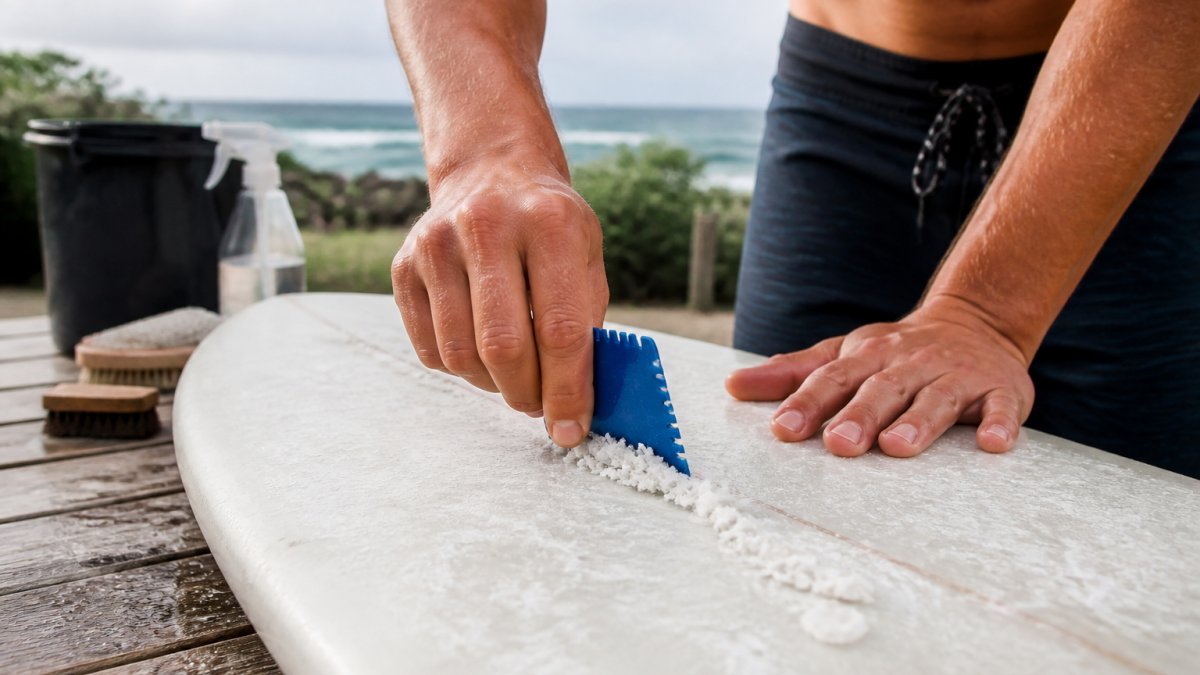
Step 1: Soften the Wax with Gentle Heat
Warm wax scrapes off in clean curls; cold wax chips and smears. Soften the top layer without cooking the board.
- Sunlight: Leave the board deck-up in direct sun for 10 to 15 minutes on a warm day. This is the gentlest method and costs nothing.
- Hairdryer: Hold it 15 to 20 cm from the deck on a low or medium setting. Keep it moving.
- Heat lamp or heat gun: Use the lowest setting and sweep constantly. Never hold it in one spot.
Stop as soon as the wax looks glossy and soft. You want it pliable, not liquid.
Step 2: Scrape with a Wax Comb or Scraper
Hold the comb or scraper at a low angle, around 30 to 45 degrees, and push the wax toward you in short strokes, working from top to tail.
- Use the flat scraper edge for thick buildup
- Use the comb teeth to rough up stubborn patches
- Let the shavings fall onto your drop cloth
Do not press hard. Let the softened wax peel away in strips. If it fights back, warm it again for a minute.
Step 3: Remove Wax from the Deck, Rails, and Hard-to-Reach Areas
The deck is easy. The rails, nose, and tail are where most people give up. A few tricks help:
- Rails: Scrape along the curve, not across it, so the tool follows the shape
- Nose and tail: Use the corner of the scraper for tight spots
- Traction pads and fin boxes: Work around them with a soft cloth and a little warmth
Leftover wax in the corners turns into a sticky trap for sand.
How to Clean Sticky Surfboard Wax Residue
Scraping leaves a thin film that makes a deck feel greasy. This step decides whether your next wax job sticks, and it is where board damage happens: the wrong solvent can dull a gloss coat, soften epoxy, or seep into a ding.
How to clean sticky surfboard wax residue: wipe the deck with a soft cloth and a mild solvent, then buff it dry before adding fresh wax. The goal is a clean, dry surface with no slick film.
Match the cleaner to the board material
Before you reach for a bottle, know what you are wiping:
- Polyester (PU) boards with a gloss coat: the most forgiving. Mild soap, isopropyl alcohol, and citrus cleaners are all generally fine on a cured gloss coat. Avoid acetone and lacquer thinner, which can dull or dissolve the finish.
- Epoxy boards: more sensitive to strong solvents. Stick to warm water, mild soap, and a diluted citrus cleaner. Test isopropyl alcohol on a small hidden spot first; repeated heavy use can cloud some epoxy finishes.
- Fiberglass with exposed weave or a sanded finish: the texture traps residue. Use a soft cloth and warm water rather than a solvent-heavy wipe, and never scrub across exposed weave with a dry cloth.
Solvent safety and ventilation
Isopropyl alcohol, citrus cleaner, and turpentine are flammable, fume-producing products. Treat them that way.
- Work outdoors or in a well-ventilated space, never in a closed garage or small room.
- Keep solvents away from open flames, pilot lights, and heat guns.
- Wear gloves if you are sensitive, and avoid breathing concentrated fumes.
Turpentine is effective but the strongest option. Use it sparingly, on a cloth rather than poured on the board, and only when milder options fail; isopropyl alcohol usually handles the last greasy film.
The wipe-and-buff sequence
- Wipe off loose shavings and sand with a dry cloth first.
- Dampen a cloth with your chosen cleaner, do not soak the board.
- Wipe in one direction, turning the cloth as it loads up.
- Follow with a clean, damp cloth to lift cleaner residue.
- Buff dry with a dry cloth and let the board air out fully before waxing.
Test any cleaner on a small hidden spot, such as near the tail or under a rail, before using it across the deck.
No Sun, No Hairdryer? Alternative Wax Removal Methods
Not every session ends in sunshine. In a cold garage, hotel room, or apartment with no outdoor space, replace gentle heat with patience and the right technique, and know when to stop rather than force a cold scrape that chips wax and scratches the deck.
Cold-weather and indoor workflow
With no sun and no hairdryer, work in thin layers instead of peeling the whole coat at once:
- Warm water soak: Pour warm, not boiling, water over a section of the deck, let it sit for a minute, then scrape while it is still warm. Refill as it cools. This is the most reliable no-tool method indoors.
- Warm, damp towel: Lay a towel soaked in warm water over the deck for a few minutes. The trapped heat softens the top layer just enough to scrape.
- Warm car on a mild day: A closed car in even weak sun softens wax gently and evenly. Check on it every few minutes so it does not overheat.
Troubleshooting stubborn, hardened, or layered wax
Old wax reapplied for months is the hardest case: it hardens, cracks, traps grit, and a single cold scrape will not clear it.
- Work in small sections. Soften and scrape one area at a time rather than the whole deck.
- Score the surface first. Drag the comb teeth across hardened wax to break the top skin so warmth can penetrate.
- Repeat heat and scrape cycles. Two or three short passes beat one long, aggressive one.
What not to do
Avoid open flames, boiling water, microwaves, and ovens. They damage boards, can delaminate glass, and are a safety risk. Never hold a heat source in one spot or leave a board unattended near heat.
Collect and dispose of the wax
Scraped wax and cleaning cloths should not end up on the beach or down a drain. Collect shavings on a drop cloth, bag them, and dispose of them with household waste unless your local program accepts wax. Wipe tools before storage so residue does not transfer to the next board.
The Best Surf Wax Remover for Your Board and the Planet
The best surf wax remover cleans your board without harming it or the ocean.
We build Surfgoo wax with organic beeswax and natural, non-toxic ingredients, so the wax you strip is gentler on the water it ends up near. Our cool water formula is made for 14°C to 20°C (58°F to 68°F) sessions and stays sticky longer.

For cleanup, a cloth and a mild, biodegradable cleaner pair well with our wax. You can shop Surfgoo cool water wax and keep the whole cycle, from application to removal, as clean as the waves you ride.
How Often to Remove Surfboard Wax
Strip and re-wax every few months of regular surfing, or roughly every 20 to 30 sessions, depending on conditions.
| Situation | How Often to Strip and Re-Wax |
|---|---|
| Regular surfing, clean water | Every 2 to 3 months |
| Sandy or warm-water breaks | Every 4 to 6 weeks |
| Cold-water sessions | Every 2 to 3 months |
| Board stored outside or in heat | Check monthly |
| Before storing long-term | Always strip first |
A few habits keep the deck healthier between strips:
- Re-wax lightly after every few sessions
- Rinse off sand and salt after surfing
- Store the board out of direct sun
Wax that sits too long hardens, cracks, and traps grit. Fresh wax grips better and lasts longer.
Conclusion
Old wax is the quiet reason a board loses its grip, and stripping it is a job most surfers avoid too long. But the process is simple: soften, scrape, clean, and re-wax. Twenty minutes resets the deck and makes every session safer.
At Surfgoo, we make handcrafted, petroleum-free wax from organic beeswax so your board care stays as clean as the ocean you surf.
Frequently Asked Questions
Does rubbing alcohol remove surf wax?
Rubbing alcohol can help lift thin wax residue after you have scraped off the bulk of the wax, but it will not dissolve a thick layer on its own. Apply a small amount to a cloth and wipe the surface, then rinse with fresh water. Test on a small area first, because alcohol can dull some board finishes. For most boards, scraping with gentle heat followed by a residue clean is faster and safer than relying on alcohol alone.
What is the best surf wax remover?
The best surf wax remover depends on your setup. A wax comb and scraper handle the bulk of removal, while gentle heat from sunlight or a hairdryer softens wax first. For residue, a dedicated wax remover or a small amount of turpentine on a cloth works, though you should rinse thoroughly afterward. If you want a low-effort option, a wax pickle or pickup block lifts leftover crumbs from the deck. Match the tool to the job rather than expecting one product to do everything.
How often should you remove old surf wax?
Most surfers should strip and re-wax every four to eight weeks, or sooner if the wax looks grey, feels slick, or stops gripping. If you surf several times a week, wax buildup and sand collect faster, so a monthly refresh makes sense. In cold water, wax hardens and cracks more quickly, which traps dirt. A good rule: when your board feels slippery underfoot or the wax layer looks patchy, it is time for surf wax removal and a fresh coat.
How do you clean sticky wax residue off a surfboard?
After scraping, wipe the board with a cloth dampened with a wax remover or a small amount of turpentine, then follow with a clean damp cloth. For stubborn patches, let the solvent sit for a minute before wiping. Rinse with fresh water and dry fully before applying new wax. Avoid pouring solvent directly on the board, and work outdoors or in a ventilated area. Dispose of wax scraps and solvent-soaked cloths responsibly, not down the drain.

