

Table of Contents
- Does Natural Surf Wax Grip Well? The Short Answer
- Why Surfboards Need Wax and How It Creates Grip
- Natural Surf Wax vs Paraffin: Performance Comparison
- Natural Wax Durability vs Paraffin Wax: What Lasts Longer
- Best Surf Wax for Water Temperature: Cold Water Performance
- How to Apply Surf Wax for Maximum Grip and Control
- Natural Ingredients, Environmental Impact, and Real Trade-Offs
- Conclusion: Making the Switch to Natural Wax
- Frequently Asked Questions
Last Updated: October 19, 2026
Does Natural Surf Wax Grip Well? The Short Answer
Yes, natural surf wax grips well when formulated correctly. At Surfgoo, we've tested our natural wax formulations extensively across different water temperatures and board conditions. The key difference isn't whether natural wax can grip, it's whether the specific blend you choose matches your water temperature and surfing style.
Most surfers assume natural wax sacrifices grip for environmental benefits. A properly engineered natural wax using organic beeswax and sustainable compounds delivers the same traction as paraffin, without the toxicity.
The real question is durability, consistency across temperature ranges, and whether the environmental trade-offs matter to your surfing.
Why Surfboards Need Wax and How It Creates Grip
Wax creates a sticky surface between your feet and the board. Without it, your feet slip across the smooth deck every time you shift weight, uncomfortable at best, dangerous in challenging conditions.
Wax has a low melting point, so it stays tacky when wet and maintains a bumpy texture your feet grip into. The bumps are what matter, smooth wax is useless wax.
Circular motions build small beads and bumps that create micro-friction. Cold water wax is harder with larger bumps; warm water wax is softer and stickier. Using the wrong type ruins your session.
Natural wax works the same way: a harder basecoat provides foundation, a softer topcoat creates the bumpy grip surface. The only difference is the source material, organic beeswax instead of petroleum-derived paraffin.
Natural Surf Wax vs Paraffin: Performance Comparison
Most surfers assume natural wax performs worse because it's "better for the environment." The truth is more nuanced.
Natural and paraffin wax behave almost identically once applied. Both grip through the same bumpy texture and respond to water temperature similarly. The difference is consistency, durability, and what happens after your session.
| Characteristic | Natural Wax | Paraffin Wax |
|---|---|---|
| Grip Quality | Excellent (when formulated correctly) | Excellent |
| Stickiness in Cold Water | Stays pliable | Can become hard |
| Stickiness in Warm Water | Stays tacky | Can become too soft |
| Durability | Varies by blend | Consistent |
| Environmental Impact | Biodegradable | Petroleum-based |
| Health Concerns | Minimal (non-toxic) | Potential carcinogenic compounds |
The key word is "formulated correctly." A poorly made natural wax performs worse, but a well-engineered one balancing organic beeswax with complementary natural compounds matches paraffin in grip and traction.
The real advantage isn't grip, it's what you're not exposed to. Paraffin is a petroleum byproduct, and some formulations contain additives that raise health concerns for regular users. Natural wax eliminates that exposure entirely.
Natural Wax Durability vs Paraffin Wax: What Lasts Longer
Durability is the objection that actually decides purchases. Grip is table stakes, both wax types grip when formulated correctly.
Wax wears through three mechanisms: mechanical abrasion from feet and wetsuit, thermal softening that lets the topcoat smear, and water action that lifts the topcoat off the basecoat.
A typical paraffin setup gives most regular surfers three to four sessions before the topcoat needs refreshing, with a basecoat lasting weeks to a couple of months. That's the benchmark natural wax must meet.
A well-formulated natural wax can meet it. The variables that determine whether it does are:
- Beeswax proportion and sourcing. Higher-quality organic beeswax gives a harder, more abrasion-resistant structure. Budget bars that stretch the blend with soft fillers wear faster.
- Basecoat hardness. If the basecoat is too soft, it breaks down and mixes with the topcoat into a messy, ineffective layer. A firm natural basecoat is what lets the topcoat do its job.
- Temperature match. A wax used outside its intended band wears faster, soft wax in warm water smears off, hard wax in cold water chips. Durability is partly a matching problem, not just a formulation problem.
- Application thickness. Over-application feels like insurance but actually shortens useful life: thick wax smears, transfers onto wetsuits, and creates buildup that has to be stripped sooner.
A common pattern among regular surfers is that a quality natural wax lands in the same range as paraffin, roughly three to four sessions per topcoat refresh, while a cheap natural bar can need refreshing every session or two.
If a natural bar lasts as long as paraffin, cost per session is comparable and the environmental and health arguments come free. If it lasts half as long, you buy twice as much product, more packaging, shipping, and waste, enough to erase the biodegradability advantage. Durability is the hinge the whole natural-wax case turns on.
At Surfgoo, our commitment to small-batch production and careful ingredient selection ensures our natural wax maintains grip without excessive buildup. We publish temperature bands for each product to help you choose the right wax for your sessions.
The buying advice: ask how many sessions a bar lasts, check that the brand formulates per temperature band, and apply a firm basecoat with a thin topcoat.
Best Surf Wax for Water Temperature: Cold Water Performance
Water temperature is the single biggest variable in wax performance, and it's where the natural-versus-paraffin conversation usually goes wrong. Most comparisons stop at cold water.
Grip comes from bumpy texture, which only holds if the wax stays in a narrow window of hardness: too hard and bumps flatten, too soft and they smear.
Here's how that plays out condition by condition:
Cold water (roughly 50-58°F). The risk is wax hardening until bumps won't form. Natural cold-water blends raise the beeswax proportion and pair it with softer compounds to stay workable. Surfers in cool-water coastal regions typically need a firmer basecoat and thinner topcoat, the basecoat does the structural work, and a thin topcoat won't chip.
Cool water (roughly 58-68°F). The easiest range for natural wax. The wax stays tacky, bumps form cleanly, and reapplication is close to paraffin, a fresh topcoat every two to three sessions. Our Surfgoo Cool Wax is formulated for this band, maintaining tack.

Warm water (roughly 68-75°F). The failure mode flips: wax softens and smears. Natural warm-water blends lean on harder waxes and fewer soft compounds.
Tropical water (75°F and up). The hardest test, and where cheap natural bars most often fail. A tropical blend must stay firm under direct sun while remaining tacky.
The takeaway: natural wax can match paraffin across the full range, but only if the manufacturer formulates per band. Ask whether the brand publishes temperature ranges. A brand that does has done the blending work; one selling a single 'all-temperature' bar is asking you to accept a compromise.
Research on wax performance across temperature ranges from surfing equipment manufacturers shows that temperature consistency is crucial. Surfers in cold water regions need wax that performs reliably regardless of seasonal shifts, and the same is true at the warm end of the range.
How to Apply Surf Wax for Maximum Grip and Control
Applying wax correctly determines whether you get maximum grip or a messy buildup. Most surfers just rub wax on the board, that's a mistake.
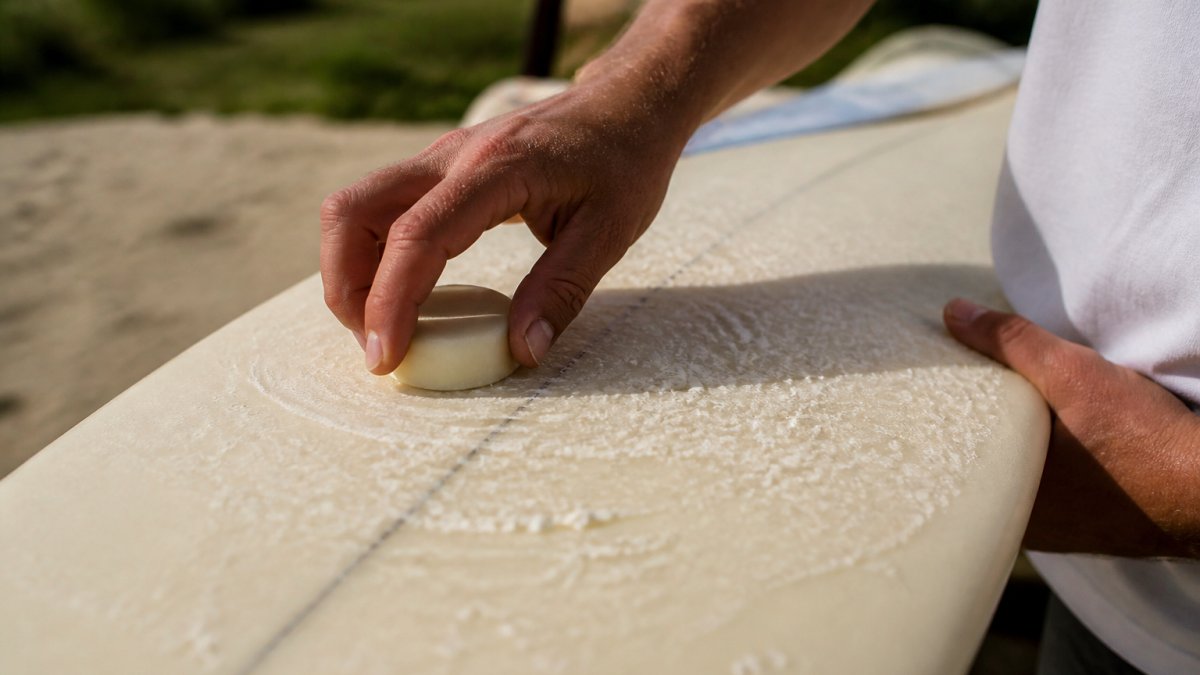
Start with a clean board. Remove old wax with a comb or by softening it in the sun and scraping it off, old wax mixed with new creates an uneven, unpredictable surface.
Apply the basecoat first with firm circular motions, creating small bumps across the middle third of the board where you stand. Don't go too light, the basecoat is your foundation.
Once the basecoat sets (a minute or two), add the topcoat with lighter pressure and smaller circles.
The common mistake is over-applying. More wax doesn't mean more grip, excessive buildup becomes slippery, messy, and ends up on your wetsuit and car interior. A thin, well-distributed layer outperforms a thick glob.
Natural wax applies identically to paraffin, though it may feel softer or different in texture depending on the blend. The goal is the same: bumpy grip surface, minimal buildup, consistent coverage.
Reapply topcoat between sessions as needed. Most surfers add fresh topcoat every two to three sessions rather than starting completely over. This maintains grip without creating excessive buildup.
Natural Ingredients, Environmental Impact, and Real Trade-Offs
Natural wax isn't automatically better for the environment, it depends on sourcing, production, and how it breaks down.
Organic beeswax, the primary ingredient in most natural surf waxes, is renewable, biodegradable, and non-toxic. Unlike paraffin, it doesn't persist in marine ecosystems, when it washes off your board, it breaks down naturally.
But there's a trade-off: not all beeswax is sourced responsibly, and natural formulations need complementary ingredients, carefully selected to stay sustainable and non-toxic, to match paraffin performance.
The health argument is stronger. Paraffin is a petroleum byproduct, and some formulations contain additives that raise concerns for regular users.
Durability complicates the environmental case: if natural wax lasts half as long, you buy twice as much product, more packaging, transportation, and waste, offsetting the biodegradability benefit.
Environmental impact studies on petroleum-based versus plant-based surfing products highlight that durability and lifespan are critical factors in lifecycle assessment. A natural product that lasts longer is more sustainable than one that requires frequent replacement.
The honest truth: natural wax is better for your health and the ocean if it's formulated well and lasts multiple sessions. If it's poorly made or needs constant reapplication, it's just another marketing claim.
Conclusion: Making the Switch to Natural Wax
Natural surf wax grips well when engineered properly. The performance difference between quality natural wax and paraffin is negligible, both create the bumpy texture your feet need. The real decision comes down to health, environmental values, and willingness to invest in a premium product.
If you're an eco-conscious regular surfer who prefers non-toxic gear, natural wax is worth trying. If you surf once a month, paraffin works fine and costs less. Either way, match the wax to your water temperature and apply it correctly.
Surfing industry standards for wax performance and safety establish that grip, durability, and user safety are the baseline requirements. Natural wax meets these standards when formulated correctly.
Frequently Asked Questions
Does natural surf wax grip as well as paraffin wax?
Natural surf wax can grip just as effectively as paraffin wax when formulated correctly. The key difference lies in the ingredients: natural wax uses organic beeswax and plant-based compounds instead of petroleum byproducts. Both create a sticky surface through the same mechanism, tiny bumps form on your board's deck that your feet grip into. Handmade natural wax like Surfgoo is designed specifically for grip performance, so you don't sacrifice traction for sustainability.
How long does natural surf wax last on a surfboard?
Quality natural wax lasts as long as conventional paraffin wax when applied correctly and matched to water temperature. A properly applied basecoat and topcoat can hold through multiple sessions. However, durability depends on how often you surf, water conditions, and whether you're reapplying fresh topcoat between sessions. Natural wax formulas that use durable beeswax compounds resist breakdown under UV exposure and salt water, meaning you won't need to strip and rewax as frequently.
Does water temperature affect natural surf wax grip?
Yes, water temperature significantly affects any wax's performance, including natural varieties. Cold water waxes stay tacky in chilly conditions, while warm water formulas resist melting in tropical heat. Natural wax formulas can be optimized for specific temperature ranges, Surfgoo's cool water wax, for example, is designed for temperatures between 58°F and 68°F. Choosing the right wax type for your local conditions ensures consistent grip and prevents your deck from becoming either too hard or too mushy.
How do you apply natural surf wax for better traction?
Start with a basecoat using firm, circular pressure to build small bumps across your deck. Then add a topcoat in the same circular motion, applying less pressure to create finer texture. The combination gives you a stable foothold for both control and maneuvers. Reapply fresh topcoat every few sessions or after wax buildup gets flat. Remove old wax buildup periodically to prevent a messy, uneven surface that reduces grip and board feel.
At Surfgoo, we've built our entire product line around the belief that performance and environmental responsibility don't have to compete. Our Cool Wax delivers superior board grip for cold water conditions using organic beeswax and sustainable ingredients. It's designed for surfers who refuse to compromise on either front, grip or values. Shop Now and experience the difference quality natural wax makes in your sessions.

